Whole Child Curriculum
Key Stage 3
At Goldwyn, Key Stage 3 provides pupils with access to our broad curriculum, ensuring that every young person experiences a rich, balanced and ambitious range of subjects.
Our curriculum is rooted in the belief that all pupils have high aspirations, receiving the personalised support and adaptations needed to succeed. Learning experiences are carefully designed to be inclusive, engaging and responsive to the needs identified within each student’s EHCP, enabling all learners to access appropriate and meaningful academic challenge.
Our teaching approach combines high-quality subject knowledge with evidence-based practice, including explicit instruction, retrieval practice, vocabulary development, communication and oracy opportunities, and regular checks for understanding. Progress is measured not solely through attainment, but through the growth each student makes from their individual starting point. By focusing on both achievement and personal development, we celebrate progress in all its forms and empower students to develop confidence, resilience and independence as learners.
Key Stage 3 lays the foundation for future success by developing academic knowledge, learning behaviours and self-belief. Through a curriculum that balances aspiration with personalised support, students are equipped with the skills, understanding and confidence needed to progress successfully into Key Stage 4 and beyond.
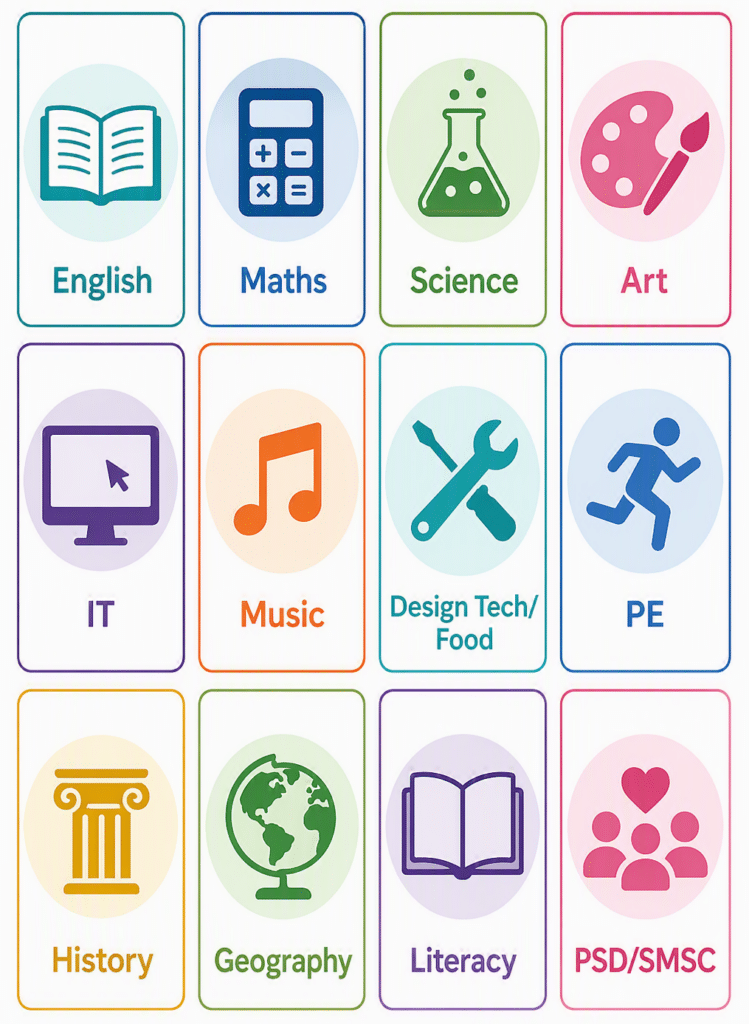
KS3 Curriculum Areas
English
In Key Stage 3, students access a carefully sequenced programme of study across fiction, non-fiction, poetry and drama, while developing the core skills of reading, writing, speaking and listening. Through the study of classic and contemporary texts, students are encouraged to think critically, explore different perspectives and develop an appreciation of language and literature. Vocabulary development, reading fluency and effective communication are prioritised throughout the curriculum to build on and secure strong Foundational Knowledge for future learning.
Lessons are designed to be inclusive and accessible, adapting content and teaching to meet the needs of all learners. Drama and LAMDA opportunities are embedded throughout Key Stage 3 to support confidence, oracy, self-expression and emotional development, recognising the important role communication plays in both academic and personal success.
Our Key Stage 3 English curriculum not only develops subject knowledge and literacy skills but also supports the wider aims of the Whole Child Curriculum. Pupils are encouraged to become resilient, independent and reflective learners who can communicate effectively and engage confidently with the world around them.
Topics are used as a vessel to build knowledge and skills, these are chosen carefully to build towards future learning and qualifications, whilst capturing and expanding the imaginations of our learners.
KS3 English Documents
KS3 English Topics
Mathematics
In Key Stage 3, Pupils follow a carefully sequenced programme of study that develops their understanding of Number, Algebra, Ratio, Geometry, Probability and Statistics. Key concepts are revisited and built upon over time, helping pupils develop confidence, fluency and a deeper understanding of mathematics.
Pupils are encouraged to explain their thinking, justify methods and apply their knowledge to a range of mathematical and real-world problems. Mathematical vocabulary is taught explicitly to support understanding and communication.
Our Key Stage 3 Mathematics curriculum not only develops mathematical knowledge and numeracy but also supports the wider aims of the Whole Child Curriculum. Pupils become resilient, independent and reflective learners who approach challenges with confidence. The curriculum is structured to provide a strong foundation for Functional Skills and GCSE Mathematics qualifications at both Foundation and Higher tier, ensuring pupils are well prepared for life beyond school.
KS3 Mathematics Documents
KS3 Maths Topics
Science
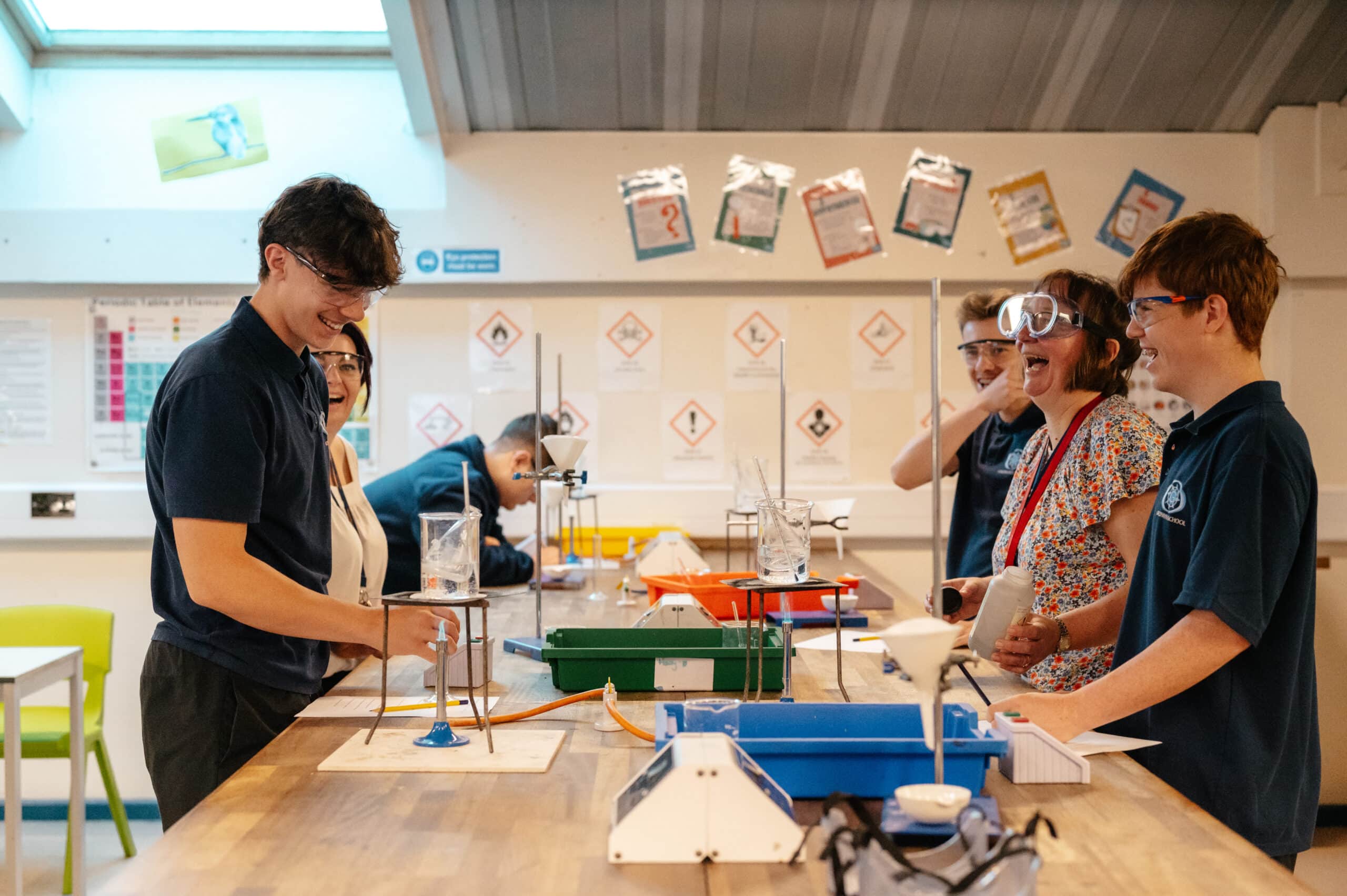
The Key Stage 3 Science curriculum introduces pupils to the fundamental principles of Biology, Chemistry and Physics through a broad and balanced programme of study. Learning is carefully planned to help pupils develop a secure understanding of scientific ideas while making links between different areas of science.
Through practical activities, demonstrations and investigations, pupils learn how scientific knowledge is developed and tested. They are encouraged to observe, question, evaluate evidence and draw conclusions, helping them develop both scientific enquiry skills and critical thinking. Key terminology is taught and reinforced to enable pupils to communicate their ideas accurately and confidently.
Lessons provide opportunities for all pupils to succeed, with appropriate challenge and support built into learning. Science is explored through relevant and engaging contexts, helping pupils understand its role in everyday life, technological innovation and the natural world.
KS3 Science Documents
KS3 Science Topics
Art
The Key Stage 3 Art & Design curriculum enables pupils to develop creativity, imagination and confidence through a broad range of practical and theoretical experiences. Pupils are encouraged to explore, experiment and take creative risks while developing a strong foundation in artistic techniques and visual communication.
Throughout the curriculum, pupils build core skills in drawing, painting, printmaking, design and mixed media. They learn how to use the formal elements of art, including colour, line, shape, form, texture, pattern and tone, to create purposeful and expressive outcomes. Observational drawing and recording are key aspects of learning, helping pupils to improve their accuracy, understanding of proportion and ability to communicate ideas visually.
Pupils investigate the work of artists, craftspeople and designers from a variety of cultures, historical periods and artistic movements. They learn how art reflects different societies and traditions, developing their ability to analyse, evaluate and respond to the work of others. Creative projects encourage pupils to explore visual storytelling, symbolism, design processes and personal expression while making connections between art and the wider world.
As they progress through Key Stage 3, pupils develop research, planning and refinement skills, learning how to generate ideas, experiment with materials and techniques, and present completed outcomes. Opportunities for independent decision-making and critical reflection help pupils become more confident, resilient and thoughtful artists.
The curriculum provides pupils with the skills and creative understanding needed to prepare them for further study at Key Stage 4 while developing an appreciation of art, design and creativity in everyday life.
IT
The Key Stage 3 ICT curriculum equips pupils with the digital knowledge and skills needed to thrive in an increasingly technology-driven world. Through a broad range of topics, pupils develop their understanding of computer systems, networks, programming, digital media and online safety while learning how technology is used in everyday life.
Across Years 7 to 9, pupils explore areas such as coding with Scratch and Microbits, spreadsheets, web development, mobile app creation, cybersecurity and digital communications. The curriculum also reflects the interests of many pupils by drawing on examples from the world of gaming, helping them make meaningful connections between classroom learning and the digital experiences they encounter beyond school.
Practical, hands-on activities encourage pupils to develop creativity, problem-solving skills and computational thinking. Digital literacy and responsible use of technology are embedded throughout the curriculum, enabling pupils to become confident, safe and informed users of digital technologies.
Music
The Key Stage 3 Music curriculum enables pupils to develop musical knowledge, performance skills and creativity through a wide range of practical and listening activities. Pupils explore music from different cultures, traditions and historical periods while building confidence as performers, composers and critical listeners.
All pupils learn to play an instrument or develop their singing skills through regular classroom music-making. They build their understanding of rhythm, melody, harmony, texture, structure and notation, learning how these elements combine to create different musical styles and genres.
Music is taught in a professional studio environment, giving pupils access to industry-standard instruments, recording facilities and music technology. Through practical performance, composition and music production activities, pupils develop technical skills while gaining experience of contemporary approaches to creating and recording music.
Pupils explore a variety of musical traditions and genres, developing their ability to listen, analyse and evaluate music using appropriate musical vocabulary. They learn how music communicates ideas, emotions and stories, while gaining an appreciation of its cultural significance.
As they progress through Key Stage 3, pupils compose, arrange, improvise and refine their own musical work, developing creativity, independence and collaboration skills. They learn to review and improve their work through reflection and feedback, preparing them for further study at Key Stage 4.
Performance is a key part of music-making within the department. Each term, pupils have the opportunity to take part in a school concert, with the majority of pupils performing throughout the year. These events help pupils develop confidence, stagecraft and a sense of achievement while celebrating musical success.
Design Technology & Food
The Goldwyn Design and Food Technology curriculum develops creative, resilient and skilled learners who can design, make and evaluate products for real-world purposes. Through a progressive range of practical projects, pupils develop confidence in problem-solving, innovation, creativity and craftsmanship whilst gaining essential life and employability skills.
In Design Technology, students work safely and accurately with a range of materials, tools and manufacturing processes, creating products such as games, lighting products, wildlife habitats and furniture. Alongside traditional workshop skills, they use modern technologies including Computer-Aided Design (CAD), laser cutting and 3D printing to design, prototype and manufacture products with increasing precision and independence.
In Food Technology, pupils develop practical cooking skills whilst building their understanding of nutrition, healthy eating, sustainability, food provenance and budgeting. Through a range of food preparation and cooking experiences, they learn to make informed food choices, adapt recipes to meet dietary needs and understand the importance of food safety and hygiene.
Across both subjects, pupils develop transferable skills including planning, measuring, interpreting technical information, problem-solving, quality control, safe working practices and working to a specification or design brief. These skills provide a strong foundation for progression into Key Stage 4 pathways, including Motor Vehicle Studies, Construction and Food Technology, preparing pupils for further study, employment and everyday life.
By combining technical knowledge, practical application and emerging technologies, the curriculum equips pupils with the confidence, independence and skills needed to succeed in an ever-changing world.
Physical Education
The Key Stage 3 Physical Education curriculum provides pupils with opportunities to develop physical competence, teamwork and confidence through a broad range of sporting activities. Across Years 7 to 9, pupils take part in football, basketball, dodgeball, rounders, cricket, athletics and fitness, building and refining their skills as they progress through the key stage.
Pupils develop key techniques, tactical awareness and an understanding of the rules and strategies associated with different sports. They are encouraged to work collaboratively, communicate effectively and demonstrate respect, leadership and sportsmanship in both competitive and recreational settings.
Practical participation is at the heart of the curriculum, enabling pupils to improve their physical fitness, coordination and overall wellbeing. Lessons also promote healthy lifestyles by helping pupils understand the importance of regular exercise, physical activity and personal fitness.
Lessons are engaging, inclusive and ambitious, ensuring all pupils are supported and challenged to achieve their best. Alongside developing sporting ability, the curriculum fosters resilience, determination and self-confidence, encouraging pupils to enjoy being active and make positive choices for their physical and mental wellbeing.
History
Our History curriculum develops curious and informed learners by exploring the stories, events and people that have shaped the modern world. History captures the imagination of many of our pupils, encouraging them to ask questions, challenge assumptions and gain a deeper understanding of how the past continues to influence life today.
Through the study of ancient, medieval and modern history, pupils build a secure understanding of key events, societies and individuals, from Ancient Mesopotamia and Roman Britain to the World Wars, the Holocaust, the Civil Rights Movement and the Northern Ireland Troubles. They explore themes including power, conflict, empire, democracy, crime and punishment, medicine and social change.
Pupils learn to analyse evidence, evaluate different interpretations and construct well-supported arguments. These skills provide a strong foundation for further study at Key Stage 4, preparing pupils to investigate historical questions, interpret sources and explain change over time.
By studying a diverse range of British and world history, pupils develop critical thinking, empathy and cultural understanding, helping them to become informed citizens who can understand the complexities of the world around them.
Geography
The Geography curriculum at Goldwyn inspires pupils to explore and make sense of an increasingly interconnected world. Through the study of people, places and environments, pupils develop an appreciation of the diversity of the planet and the complex relationships between human activity and the natural world.
Pupils investigate a wide range of physical and human geographical topics, including rivers, coasts, weather and climate, biomes, natural hazards, settlements and population change. They also examine contemporary global issues such as climate change, energy, globalisation, tourism and development, whilst deepening their understanding of countries including Japan and China.
Through map work, data analysis and geographical enquiry, pupils learn to interpret information, identify patterns and consider different perspectives. They are encouraged to think critically about the challenges facing communities and environments at local, national and global scales.
PSD & SMSC
Our Personal, Social Development (PSD) curriculum equips pupils with the knowledge, understanding and personal skills needed to lead safe, healthy and successful lives. Through a carefully sequenced programme based on the Relationships, Sex and Health Education qualification, pupils develop the confidence to make informed decisions about their wellbeing, relationships and future aspirations.
Throughout Key Stage 3, pupils explore identity, healthy relationships, respect, equality, diversity, physical and mental health, online safety and preparation for adulthood. They learn how influences such as peers, media and social media can affect their choices, relationships and sense of self.
As they progress through Years 7 to 9, pupils develop their understanding of healthy lifestyles, resilience, mental health, managing risk, consent, discrimination, employability skills and positive relationships. Through discussion, reflection and enquiry, they learn to communicate effectively, make responsible decisions and contribute positively to their communities.
The curriculum also provides pupils with the opportunity to gain a nationally recognised qualification in Relationships, Sex and Health Education. Learning in Key Stage 3 supports achievement of the Level 1 Award, with opportunities to continue into Key Stage 4 and progress to a Level 2 qualification.
By studying PSD, pupils develop the self-awareness, resilience and decision-making skills needed to maintain positive relationships, support their wellbeing and become responsible, informed and active members of society.
In addition to PSD, we develop the personal development of pupils through a curriculum of SMSC and British Values, pupils explore identity, diversity, democracy, equality, justice and citizenship, enabling them to become confident, responsible and respectful members of society. The lessons run alongside activities and opportunities from external speakers and experiences.
Across Key Stage 3, pupils develop an understanding of their own values and beliefs while learning about the importance of community, inclusion, human rights and active citizenship. Through discussion, debate and reflection, they learn to consider different viewpoints, think critically about social issues and engage positively with the world around them.
The curriculum promotes resilience, self-awareness and readiness for adulthood, helping pupils develop the knowledge, skills and values needed to make informed decisions and contribute positively to modern British society. Pupils record their learning through a Personal Development Portfolio, evidencing their growth and understanding over time